Table of Contents
- 1. Netflix: The Gold Standard, Now Pricier
- 2. Max: The Premium Content Powerhouse
- 3. Disney+: The Family Fortress
- 4. Amazon Prime Video: The Freebie (Sort Of)
- 5. Apple TV+: Small Library, Stellar Quality
- 6. Peacock: The Budget Contender
- 7. Paramount+: Underrated and Improving
- 8. Hulu: The Network TV Companion
- Comparison Summary
- Final Thoughts: The Rotation Strategy Wins
The golden age of streaming has turned into the era of tough choices. In 2026, the average U.S. household subscribes to 4.7 streaming services, paying a combined $87 per month - more than the average cable bill was a decade ago, according to Deloitte's 2026 Digital Media Trends report. With price hikes becoming an annual tradition and content libraries splintering across platforms, finding the best value for your entertainment dollar now requires careful navigation. We compared the eight major streaming services across pricing, content quality, original programming, and overall value to help you decide.
"The average U.S. household subscribes to 4.7 streaming services, paying a combined $87 per month - more than the average cable bill a decade ago." - Deloitte 2026 Digital Media Trends
1. Netflix: The Gold Standard, Now Pricier
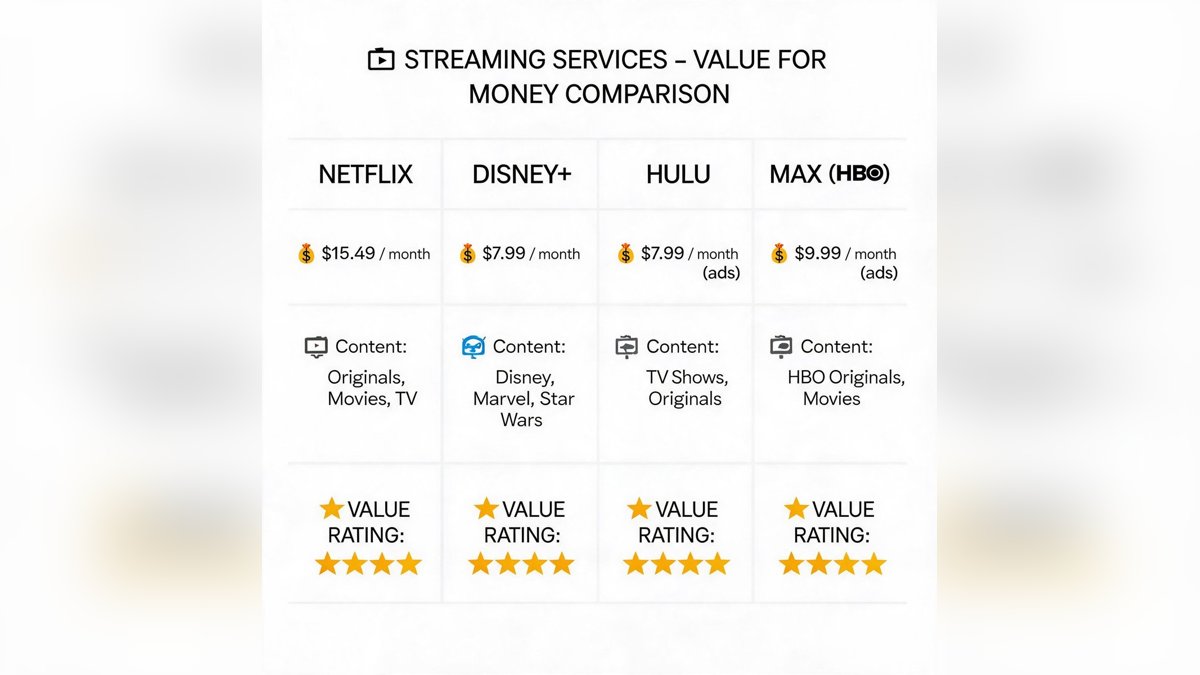
Netflix remains the biggest player with over 260 million subscribers worldwide, but pricing has climbed steadily. In 2026, Standard with Ads costs $7.99, Standard (no ads) runs $15.49, and Premium hits $22.99. Netflix leads in sheer volume with over 17,000 titles globally and invested $18 billion in content in 2025, focusing on hits like the final seasons of "Stranger Things" and "The Crown" alongside live events like weekly WWE Raw. The ad-supported tier is a genuine bargain at $7.99, offering nearly the full library with reasonable ad loads.
Verdict: Best for variety and originals, but only the ad-supported tier represents strong value.
2. Max: The Premium Content Powerhouse
Max blended HBO's prestige programming with Discovery's unscripted content into a massive library. Pricing: With Ads at $9.99, Ad-Free at $16.99, Ultimate at $20.99. What sets Max apart is the unmatched quality of HBO originals - "House of the Dragon," "The Last of Us," and a robust documentary slate. The addition of HGTV, Food Network, and exclusive Studio Ghibli films through 2028 gives Max incredible breadth.
Verdict: The $9.99 ad-supported tier is arguably the best deal in streaming given the HBO back catalog alone. Highly recommended.
3. Disney+: The Family Fortress
Deeply integrated with Hulu and ESPN+ through the Disney Bundle strategy. Standalone pricing: $8.99 with ads, $13.99 without. The full bundle costs $14.99 with ads. The library spans Disney, Pixar, Marvel, Star Wars, and National Geographic, plus Hulu's adult-oriented content. The interface is among the best with excellent parental controls. However, standalone Disney+ feels thin for adults without kids.
Verdict: Essential for families. The Disney Bundle at $14.99 for three services is excellent value.
4. Amazon Prime Video: The Freebie (Sort Of)
Bundled with Amazon Prime at $14.99 per month or $139 per year, or $8.99 standalone with ads. Even Prime members now see limited ads unless they pay an extra $2.99. The library is deep with over 12,000 movies and 2,000 shows, including "Rings of Power," "Reacher," and "Fallout." The interface remains cluttered, but as a package deal with shipping, music, and photo storage, it is hard to beat.
Verdict: Excellent value as part of Amazon Prime membership. Marginal as a standalone service.
5. Apple TV+: Small Library, Stellar Quality
Offers the smallest library of any major streamer (around 250 titles) but its hit rate for critical acclaim is unmatched. Priced at $9.99 with no ads - refreshingly simple. Shows like "Severance," "Silo," "The Morning Show," and "Slow Horses" have earned dozens of Emmy nominations. The small library makes it best suited for periodic subscriptions - sign up for a month when a new season drops, then pause.
Verdict: Best for quality-over-quantity viewers. Subscribe for a month or two per year rather than continuously.
6. Peacock: The Budget Contender
Priced at $5.99 with ads, $11.99 without - the cheapest premium streamer. Strengths include live content (Premier League soccer, WWE, NFL Sunday Night Football) and NBC sitcom classics ("The Office," "Parks and Rec," "30 Rock"). Next-day access to current NBC shows makes it a strong companion for cord-cutters. Original hits include "The Traitors" and "Poker Face." The interface lags behind competitors, but the price is hard to argue with.
Verdict: Outstanding budget option at $5.99. Perfect for sports fans and sitcom lovers.
7. Paramount+: Underrated and Improving
Pricing: $5.99 with ads (Essential), $11.99 without (Showtime). The library includes CBS, Paramount movies, Nickelodeon, MTV, and Showtime originals. Standout programming includes "Yellowstone," the "Star Trek" universe (five active series), and "South Park" exclusivity. Live sports including NFL on CBS and UEFA Champions League add significant value. The main weakness is marketing - consumers simply forget it exists.
Verdict: Underrated value at $5.99. Best for Star Trek fans and sports viewers.
8. Hulu: The Network TV Companion
Standalone pricing: $7.99 with ads, $17.99 without - but the Disney Bundle often makes standalone Hulu hard to justify. Its sweet spot is current TV, with ABC, Fox, and NBC shows arriving the day after airing. Originals include "The Handmaid's Tale," "Only Murders in the Building," and "The Bear." At $7.99 with ads, it competes with Peacock and Paramount+ at lower prices, while its ad-free tier at $17.99 is among the most expensive.
Verdict: Best as part of the Disney Bundle. Standalone only makes sense for heavy network TV viewers.
Comparison Summary
- Best Overall Value: Max With Ads ($9.99)
- Best Budget Pick: Peacock With Ads ($5.99) or Paramount+ Essential ($5.99)
- Best for Families: Disney Bundle With Ads ($14.99 for three services)
- Best for Quality: Apple TV+ ($9.99, no ads)
- Best Variety: Netflix Standard with Ads ($7.99)
- Best Value-Add: Amazon Prime Video (included with Prime)
"The best streaming strategy in 2026 is rotation: subscribe to one or two services at a time, binge what you want, then cancel and move to the next."
Final Thoughts: The Rotation Strategy Wins
The era of subscribing to five or six services simultaneously is fading. Smart consumers adopt a rotation strategy: maintain one anchor subscription (Netflix or Amazon Prime) and rotate a second premium service month to month. This cuts the average monthly streaming bill from $87 to around $25-35 while still giving you access to everything you want over a year. Always choose the ad-supported tier when available - the difference between $5.99 and $15.49 per service adds up fast, and ad loads remain reasonable at 4-6 minutes per hour.
The streaming landscape has become increasingly competitive as platforms fight for subscriber attention and retention in a crowded market. Each service is developing distinct identities through exclusive content deals, original programming strategies, and unique user experience features. Understanding what each platform offers helps consumers make informed decisions about which services deserve their monthly subscription budget and which might be worth rotating based on content release schedules throughout the year.
Behind the scenes, streaming platforms invest heavily in data analytics to predict which shows and movies will resonate with audiences. These algorithms influence everything from greenlight decisions to marketing strategies, creating a feedback loop where viewer preferences shape future content production. Critics argue this can lead to formulaic programming, while supporters point to the unprecedented variety of niche content that data-driven platforms can economically justify producing for underserved audiences.
The economics of streaming continue to shift, with most major platforms having recently adjusted their pricing structures. Ad-supported tiers have emerged as a popular middle ground, offering lower monthly fees in exchange for commercial breaks. This model has proven attractive to budget-conscious viewers and opened new revenue streams for platforms, suggesting that the streaming market is settling into a sustainable equilibrium that serves different consumer segments with appropriate price points.
The streaming landscape has become increasingly competitive as platforms fight for subscriber attention and retention in a crowded market. Each service is developing distinct identities through exclusive content deals, original programming strategies, and unique user experience features. Understanding what each platform offers helps consumers make informed decisions about which services deserve their monthly subscription budget and which might be worth rotating based on content release schedules throughout the year.
Behind the scenes, streaming platforms invest heavily in data analytics to predict which shows and movies will resonate with audiences. These algorithms influence everything from greenlight decisions to marketing strategies, creating a feedback loop where viewer preferences shape future content production. Critics argue this can lead to formulaic programming, while supporters point to the unprecedented variety of niche content that data-driven platforms can economically justify producing for underserved audiences.
The economics of streaming continue to shift, with most major platforms having recently adjusted their pricing structures. Ad-supported tiers have emerged as a popular middle ground, offering lower monthly fees in exchange for commercial breaks. This model has proven attractive to budget-conscious viewers and opened new revenue streams for platforms, suggesting that the streaming market is settling into a sustainable equilibrium that serves different consumer segments with appropriate price points.
The streaming landscape has become increasingly competitive as platforms fight for subscriber attention and retention in a crowded market. Each service is developing distinct identities through exclusive content deals, original programming strategies, and unique user experience features. Understanding what each platform offers helps consumers make informed decisions about which services deserve their monthly subscription budget and which might be worth rotating based on content release schedules throughout the year.
Behind the scenes, streaming platforms invest heavily in data analytics to predict which shows and movies will resonate with audiences. These algorithms influence everything from greenlight decisions to marketing strategies, creating a feedback loop where viewer preferences shape future content production. Critics argue this can lead to formulaic programming, while supporters point to the unprecedented variety of niche content that data-driven platforms can economically justify producing for underserved audiences.
The economics of streaming continue to shift, with most major platforms having recently adjusted their pricing structures. Ad-supported tiers have emerged as a popular middle ground, offering lower monthly fees in exchange for commercial breaks. This model has proven attractive to budget-conscious viewers and opened new revenue streams for platforms, suggesting that the streaming market is settling into a sustainable equilibrium that serves different consumer segments with appropriate price points.